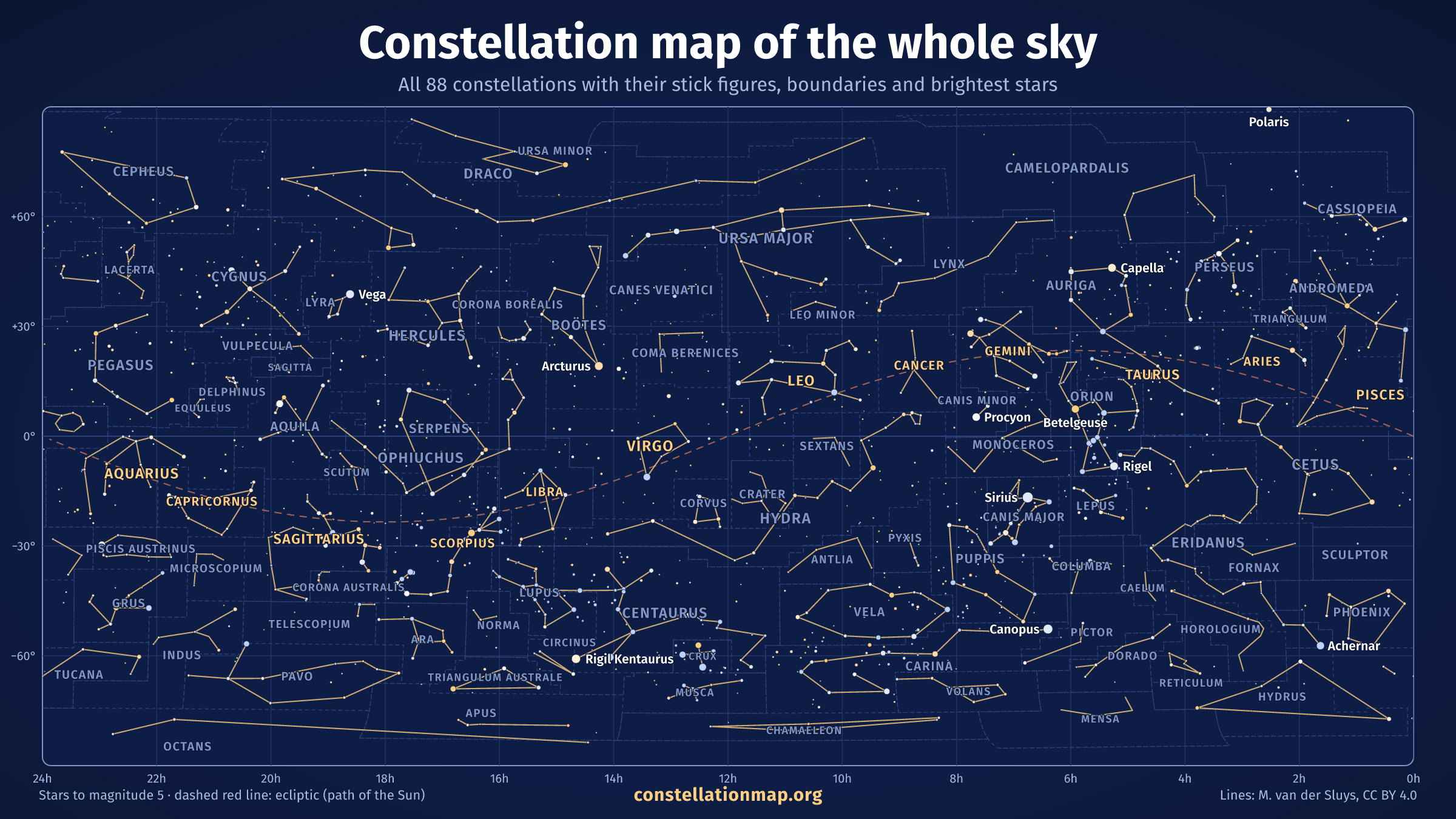

Map of all 88 constellations
The whole sky on one map: right ascension runs from right to left (east is on the left when you look up), declination from the North Celestial Pole at the top to the South Celestial Pole at the bottom. Zodiac constellations are gold; the dashed line is the ecliptic, the path of the Sun, Moon and planets.
Northern and southern sky
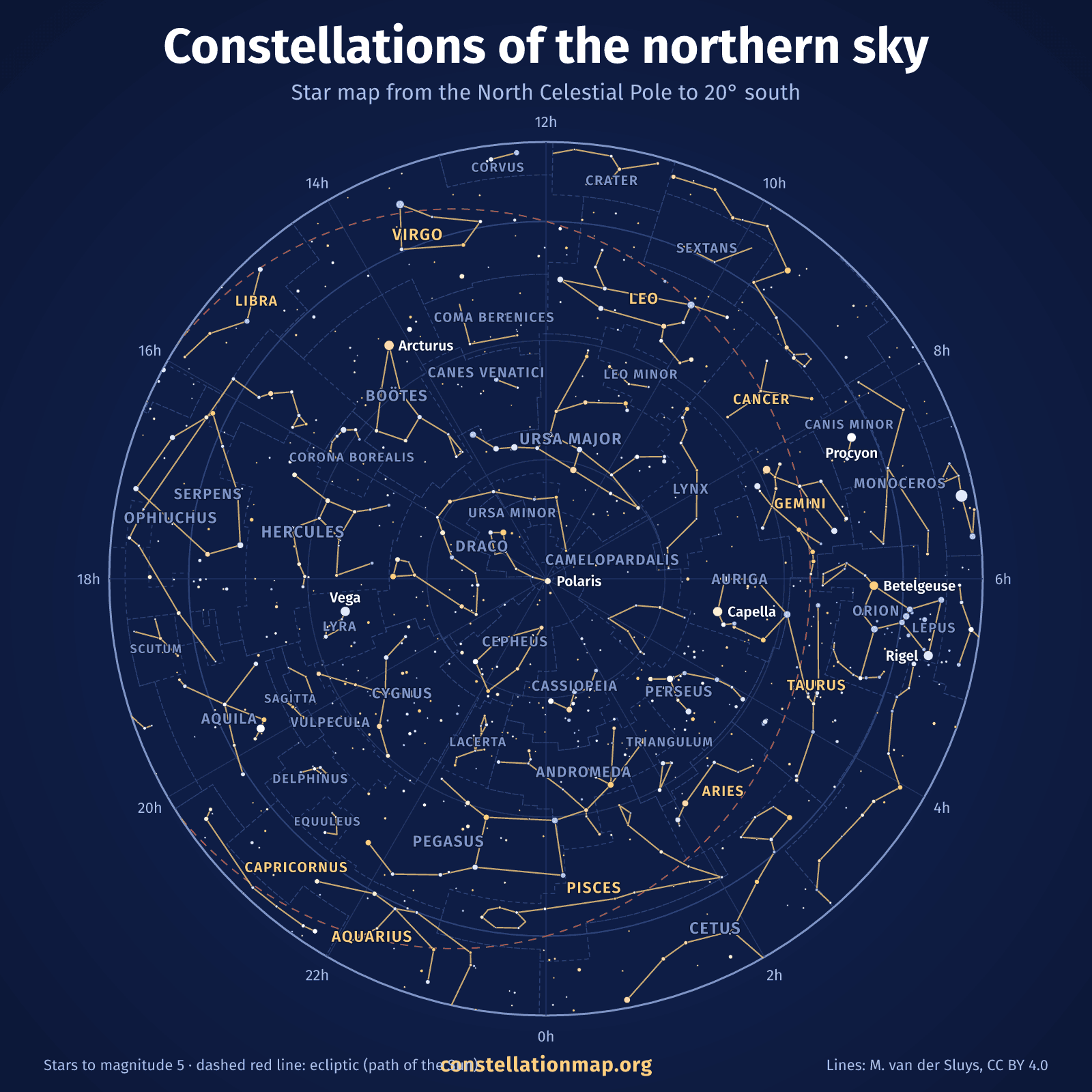
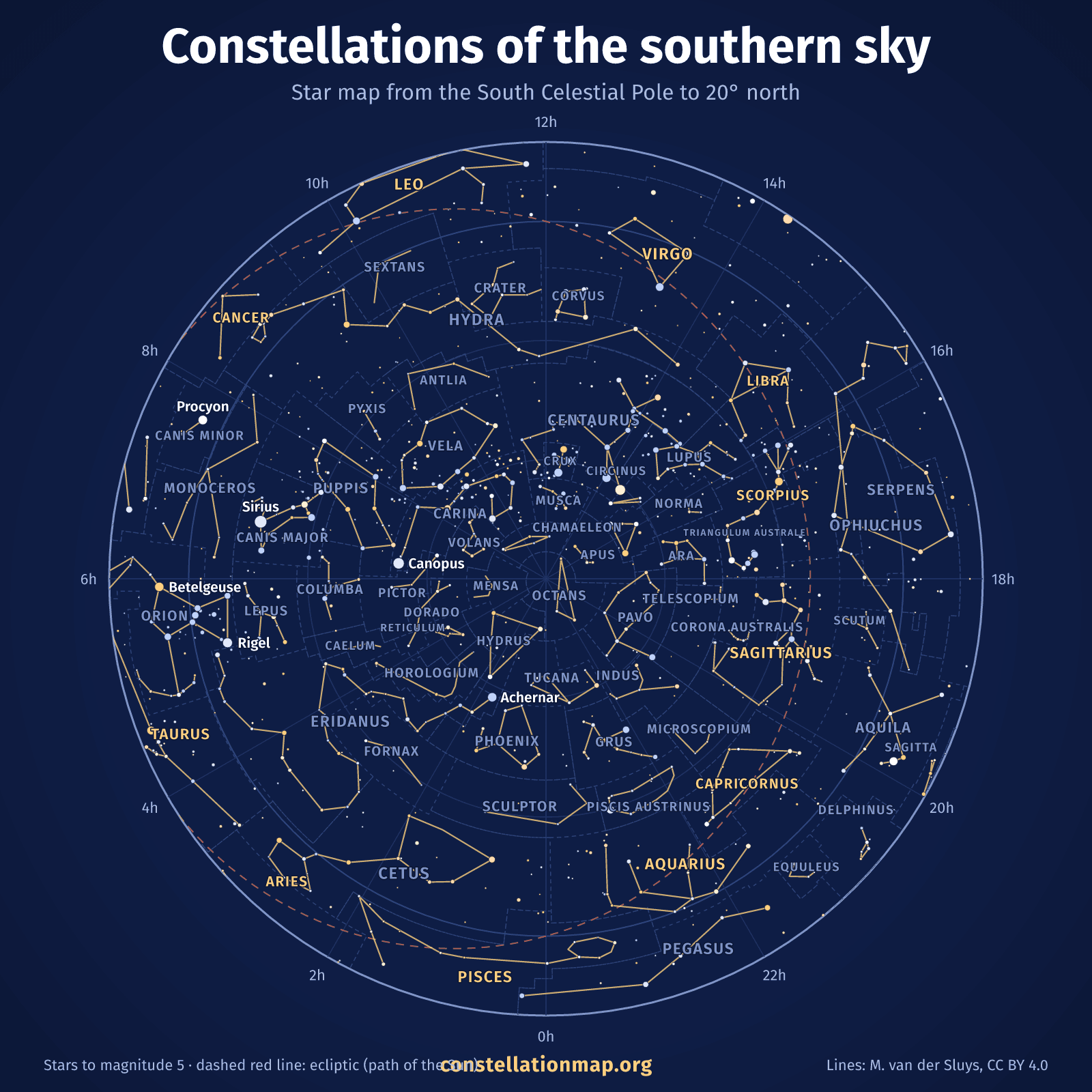
Round maps centered on the celestial poles show the sky the way it turns overnight: the northern map is centered near Polaris, the southern map on the South Celestial Pole near the Southern Cross.


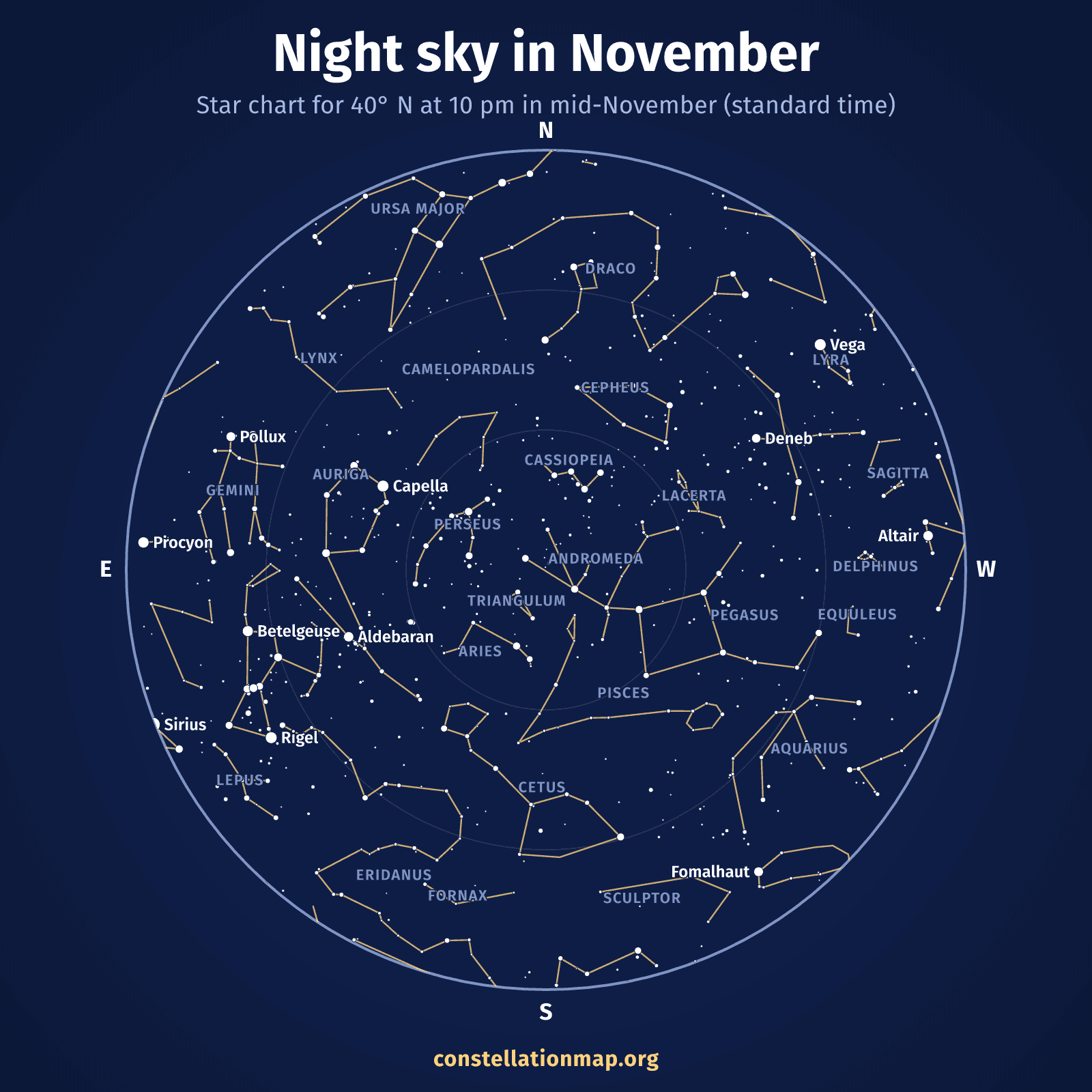
Night sky this month
Popular constellations
 Orionthe Hunter
 Ursa Majorthe Great Bear
 Cassiopeiathe Queen
 Scorpiusthe Scorpion
 Leothe Lion
 Cygnusthe Swan
 Lyrathe Lyre
 Taurusthe Bull
 Geminithe Twins
 Sagittariusthe Archer
 Cruxthe Southern Cross
 Ursa Minorthe Little Bear
See all: The 88 constellations →
Constellations by season
The constellations that are highest in the evening sky (around 9 pm) in each season, as seen from the Northern Hemisphere. South of the equator the seasons are reversed: the winter constellations of the north are summer constellations there.
Brightest stars
The brightest stars of the night sky, ranked by apparent magnitude (smaller numbers are brighter).
- SiriusCanis Major−1.46
- CanopusCarina−0.72
- Rigil KentaurusCentaurus−0.27
- ArcturusBoötes−0.04
- VegaLyra0.03
- CapellaAuriga0.08
- RigelOrion0.12
- ProcyonCanis Minor0.38
- AchernarEridanus0.46
- BetelgeuseOrion0.5
See all: Brightest stars and star names →
Galaxies, nebulae and star clusters
The best-known Messier objects, with finder charts that show where to point binoculars or a small telescope.
 Andromeda Galaxy (M31)spiral galaxy · Andromeda
 Orion Nebula (M42)emission nebula · Orion
 Pleiades (M45)open cluster · Taurus
 Hercules Globular Cluster (M13)globular cluster · Hercules
 Ring Nebula (M57)planetary nebula · Lyra
 Crab Nebula (M1)supernova remnant · Taurus
 Whirlpool Galaxy (M51)spiral galaxy · Canes Venatici
 Lagoon Nebula (M8)emission nebula · Sagittarius
See all: The Messier catalog →
Explore the atlas
Questions about the constellations
How many constellations are there?
There are 88 official constellations. The International Astronomical Union fixed the list and their boundaries in 1922 and 1930, so that every point of the sky belongs to exactly one constellation. 31 lie mostly in the northern sky and 48 mostly in the southern sky.
What is the largest constellation?
Hydra is the largest constellation, covering 1,303 square degrees, followed by Virgo and Ursa Major. The smallest is Crux with 68 square degrees.
What is the brightest star in the night sky?
Sirius in Canis Major, at magnitude −1.46. It is followed by Canopus, Rigil Kentaurus and Arcturus.
Can I use these star maps?
Yes. All maps, charts and PDFs are free to use, print and share under CC BY 4.0, also commercially and in schoolwork; please credit "Atlas of the Sky (constellationmap.org)".
Free to use with credit: Atlas of the Sky (constellationmap.org), CC BY 4.0 · More